What a Credible Halal Certification Body Actually Looks Like- November 20, 2026
The global halal market is projected to exceed $5 trillion, yet the certification bodies that underwrite its claims operate in a fragmented and uneven landscape.
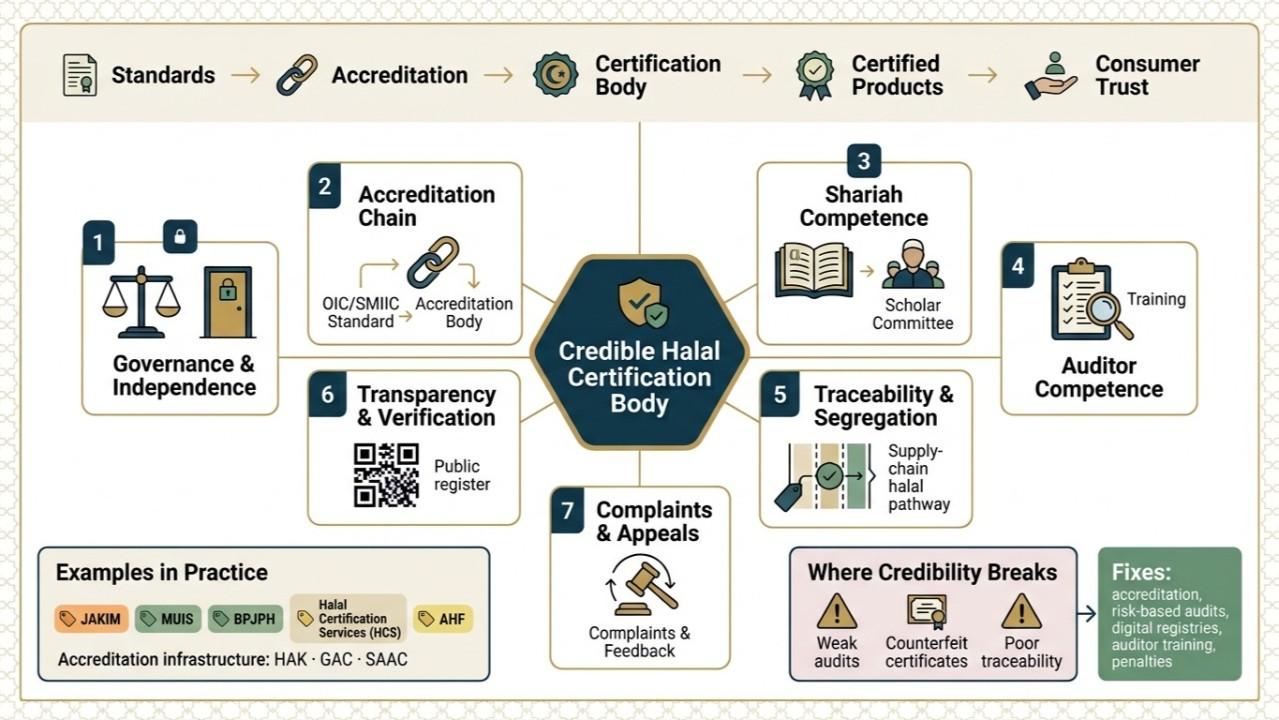
The global halal market is projected to exceed $5 trillion, yet the certification bodies that underwrite its claims operate in a fragmented and uneven landscape. Consumers in Jakarta, London, and Dubai see the same crescent-and-Arabic-script logos, but behind those marks sit radically different institutional realities: some certifiers are government departments with statutory authority; others are private companies with a handful of auditors and no external accreditation. The result is a trust deficit. Mislabeling, counterfeit certificates, and weak traceability systems have become systemic vulnerabilities, and the proliferation of certifiers has made it difficult for buyers and regulators to distinguish rigor from ritual.
A credible halal certification body is not defined by the piety of its intentions. It is defined by institutional design: the structures, processes, and accountabilities that make it difficult for a wrong decision to be made and easy for a wrong decision to be caught. What follows is a detailed anatomy of that design, grounded in international standards and illustrated with bodies that have earned recognition across borders.
The Architecture of Credibility
Governance and Independence
The first test of any certification body is whether it can say “no” to a paying client. A credible body separates commercial pressure from certification decisions through formal governance. The OIC/SMIIC 2:2019 standard—the closest thing to a global benchmark for halal certification bodies—requires a management structure with defined roles, impartiality safeguards, and a formal decision-making committee. Turkey’s Halal Accreditation Agency (HAK) illustrates how this is operationalized: a five-member Board of Directors holds ultimate decision-making authority, while a separate Complaint and Appeal Committee, chaired by the Secretary General, adjudicates disputes.
Independence is not merely a matter of org-chart boxes. Credible bodies require staff and auditors to sign declarations of impartiality, refuse assignments where past relationships exist (typically for at least two years), and maintain a standing impartiality committee that reviews risks to objectivity. The American Halal Foundation (AHF), for instance, publishes a top-management declaration committing the organization to “strict avoidance of conflict of interest” and maintains procedures designed to “minimize and eliminate risks to impartiality”. These are not marketing gestures; they are auditable controls that an accreditation body will test.
Accreditation: The Credibility Multiplier
A halal certificate is only as trustworthy as the body that issued it—and a certification body is only as trustworthy as the body that accredits it. The emerging global architecture is built on a three-layer chain: standards (OIC/SMIIC), accreditation of certification bodies against those standards, and mutual recognition among accreditors. SMIIC, the standards arm of the Organisation of Islamic Cooperation, develops the OIC/SMIIC series; national accreditation bodies then assess certification bodies against OIC/SMIIC 2:2019. Saudi Arabia’s SAAC launched its halal certification body accreditation service explicitly to “enhance the competence and integrity of entities in this field” according to OIC/SMIIC 2:2019.
The gold standard is accreditation by a signatory to a multilateral recognition arrangement. HAK, for example, accredits bodies such as the Islamic Foundation of Ireland under OIC/SMIIC 2:2019, and its accredited entities include Türk Standardları Enstitüsü and IFC Global Halal Sertifikasyon. When a certification body carries accreditation from a recognized halal accreditation body, it means an independent third party has examined its competence, its impartiality, and its operational consistency—not just its Shariah credentials.
Suggestion: A certification body that cannot name its accreditor, the standard against which it was assessed, and the scope of that accreditation should be treated as unverified. The absence of accreditation is not proof of incompetence, but it shifts the entire burden of due diligence onto the buyer.
Shariah Competence and the Role of Scholars
Halal certification is a religious judgment as well as a technical audit. A credible body embeds Shariah expertise into its decision-making, not as a ceremonial advisory board but as an operational function. OIC/SMIIC 2:2019 requires halal certification bodies to have access to competent Shariah personnel and to integrate Islamic sensitivity into their processes.
Malaysia’s JAKIM, the central halal authority, requires assessments to be conducted by at least two Shariah officers, with audit reports endorsed by a committee appointed by JAKIM. Indonesia’s BPJPH, operates on a division of labor that is instructive: LPPOM as one of the LPHs conducts the technical audit and issues a halal recommendation, while the MUI Fatwa Commission issues the actual fatwa on halalness. The certifying body does not manufacture religious authority; it feeds evidence into a separate scholarly decision-making process. This separation protects both the integrity of the fatwa and the independence of the audit.
Switzerland's HCS maintains multiple committees, including an Islamic Affairs Committee and an International Shari’ah Committee, alongside its certification decision committee. The structure signals that Shariah review is not a one-off sign-off but an ongoing governance function.
Auditor Competence: Beyond the Checklist
The credibility of a certificate collapses if the audit that produced it was superficial. OIC/SMIIC 2:2019 and the accreditation guidelines that operationalize it impose specific competence requirements: auditors must be trained in audit techniques based on ISO 19011, and where the scope covers food or slaughtering, they must also have competence in food safety management standards such as ISO 22000 or FSSC 22000. HAK’s guidelines require that contract review personnel complete training in audit processes, and that in-house training on OIC/SMIIC standards be delivered by trainers who have themselves received formal training from HAK or SMIIC.
Competence is not only technical. Halal auditing requires the ability to interrogate supply chains, verify documentation, and recognize where haram contamination can enter a process—from shared transport vehicles to cleaning agents to enzymatic processing aids. A credible body maintains records of auditors’ qualifications, training, and experience, and assigns auditors only within their demonstrated competence. It also avoids the trap of the “one-auditor-fits-all” model: a chemical engineer may be qualified to assess a cosmetics facility but not a slaughterhouse.
Operational Rigor: Traceability, Segregation, and Surveillance
A halal certificate is a claim about a supply chain, not just a factory. The weakest link is almost always the boundary between certified and non-certified material. Credible bodies impose identity-preservation requirements: strict segregation of certified ingredients, dedicated equipment where feasible, clear labeling of certification status at every stage, and documentation that allows each lot to be traced back to approved suppliers. The American Halal Foundation, for example, requires companies to retain bills of lading, supplier certificates, halal statements, and sanitation records for transport vehicles to verify that halal identity was preserved through the chain.
Certification is also not a one-time event. A credible body conducts surveillance audits, and those audits include on-site verification, not merely desk reviews of paperwork. The Salaam Gateway analysis recommends risk-based testing rather than blanket audits: focus analytical resources on the ingredients and processes where adulteration or cross-contamination is most likely, and use chain-of-custody documentation as the spine of the audit. A body that certifies a product once and never returns is not certifying a process; it is certifying a snapshot.
Transparency and Verifiable Claims
A credible certification body makes it possible for an outsider to verify its claims. The most basic transparency mechanism is a public register of certified clients and the scope of their certification. More advanced mechanisms include QR-linked certificate registries that allow a consumer or importer to confirm that a certificate is genuine and currently valid. The Salaam Gateway analysis identifies such registries as a direct countermeasure to counterfeit certificates. A body that cannot tell you which products are currently certified under its mark, and which have been withdrawn or suspended, is asking for trust without offering verification.
Transparency also extends to the body’s own rules. OIC/SMIIC 2:2019 includes explicit requirements on transparency, and accreditation assessments examine whether the body’s certification requirements, fees, and procedures are publicly accessible and non-discriminatory. A body that operates behind a wall of confidentiality may be protecting its clients, but it is also protecting itself from scrutiny.
Complaints, Appeals, and Accountability
No certification system is error-free. The mark of a credible body is what happens when someone alleges an error. OIC/SMIIC and accreditation requirements mandate a documented complaints and appeals process, with decisions made by persons not involved in the original certification decision. Good practice includes defined timelines: acknowledgment within days, substantive response within weeks, and appeals decided by an independent panel that includes Shariah representation where religious judgments are at issue.
HAK’s Complaint and Appeal Committee is a structural example: it is a standing committee with a defined chair and a unanimous decision rule, separate from the operational departments that make accreditation decisions. HCS maintains a dedicated Committee for Handling Appeals and Complaints alongside its certification decision committee. The existence of such a committee is not sufficient; it must have the authority to overturn decisions and the independence to do so without fear of commercial consequence.
What Credible Bodies Look Like in Practice
The global landscape contains several distinct models, each with lessons for what credibility requires.
Government-anchored models: JAKIM (Malaysia) and MUIS (Singapore). Malaysia’s JAKIM is the most centralized model: a government department under the Prime Minister’s Department that serves as the sole regulatory authority for halal certification, operating the MyeHALAL system and coordinating with state Islamic authorities. Its credibility rests on statutory backing, a national standard (MS1500), and a dense web of mutual recognition arrangements. Singapore’s MUIS, the Islamic Religious Council of Singapore, plays a similar role in a smaller jurisdiction and is widely recognized by major importing markets. The strength of this model is accountability to a public regulatory framework; the risk is politicization and the difficulty of scaling a government department to meet commercial demand.
Scholarly-institutional models: LPPOM MUI (Indonesia). LPPOM MUI illustrates a hybrid model in which a technical assessment institute under a religious authority conducts audits and issues recommendations, while the MUI Fatwa Commission issues the religious ruling. Indonesia’s regulatory framework has evolved so that BPJPH, the government halal product assurance agency, issues certificates on the basis of MUI’s fatwa and LPPOM’s audit. The credibility of this model depends on the independence of the fatwa process from commercial and political pressure, and on the technical competence of the auditing institute. LPPOM MUI’s list of approved foreign certifiers—40 bodies from 24 countries across slaughtering, raw material, and flavor categories—shows how a credible body can act as a gatekeeper for an entire import market.
Accreditation-anchored private models: HALAL CONTROL and AHF. Germany’s HALAL CONTROL, founded in 2001, was the first independent professional halal certification body in Germany and was recognized by Malaysia, Indonesia, and Singapore as early as 2004. It holds accreditations and recognitions from HAK, GAC, JAKIM, BPJPH, MUIS, and a long list of national authorities, and it maintains the committee structure—impartiality, Islamic affairs, international Shari’ah, certification decision, and appeals—that the OIC/SMIIC framework expects. The American Halal Foundation represents a similar model in the United States, with explicit impartiality policies and identity-preservation requirements. The credibility of these bodies is not derived from state authority; it is constructed through accreditation, recognition by importing-market authorities, and auditable management systems.
Accreditation bodies as credibility infrastructure: HAK, GAC, and SAAC. A credible certification body needs a credible accreditor. HAK accredits certification bodies against OIC/SMIIC 2:2019 and maintains a public list of accredited entities. The GCC Accreditation Center (GAC) performs the same function for the Gulf states, and SAAC has recently launched halal certification body accreditation in Saudi Arabia. The emergence of these accreditation bodies is arguably the single most important institutional development in the field: it creates a layer of independent assessment that did not exist when halal certification was dominated by self-declared religious authorities.
Where Credibility Breaks Down—and What to Do About It
The fragmented state of halal certification is not an accident. It reflects the absence of a single global enforcement mechanism, the commercial incentives of certifiers to compete on price and speed rather than rigor, and the difficulty of harmonizing Shariah interpretations across schools of thought and national jurisdictions. The vulnerabilities are well documented: mislabeling, counterfeit certificates, weak traceability, and a shortage of competent auditors. The following suggestions address the most consequential gaps.
- Make accreditation a market-access requirement, not a voluntary badge. The most effective lever is importer demand. When a major importing market—Indonesia, Malaysia, Saudi Arabia, the UAE—requires that certificates be issued by a body accredited by a recognized halal accreditation body, the entire chain tightens. BPJPH’s approved-foreign-certifier list already functions this way for the Indonesian market. Exporters and brands should treat accreditation status as a non-negotiable procurement criterion, not a differentiator to be traded off against cost.
- Shift from document audits to risk-based supply-chain verification. The weakest point in halal certification is the gap between what is written in a file and what is happening on a loading dock. Mandatory chain-of-custody documentation, segregation and cleaning protocols at critical control points, and risk-based testing targeted at high-risk ingredients should be baseline requirements, not premium options. Auditors should be trained to follow material flows, not just check boxes.
- Build verifiable digital infrastructure. QR-linked certificate registries and tamper-evident digital certificates would make counterfeit certification dramatically harder and would allow consumers, importers, and regulators to verify claims in real time. Blockchain-based traceability pilots are promising, but the minimum viable intervention is simpler: a public, searchable register of certified products and valid certificates, maintained by the certification body and linked to its accreditation status.
- Strengthen the competence pipeline for Shariah auditors. The shortage of competent halal auditors is a structural constraint on credibility. Certification bodies, accreditation bodies, and universities should collaborate on formal training pathways that combine Shariah jurisprudence, food science, supply-chain auditing, and ISO 19011 audit techniques. In-house training should be permitted only where trainers are themselves formally qualified, as HAK’s guidelines require. The goal is a professional cadre of halal auditors with portable, verifiable credentials—not a guild of self-certified inspectors.
- Give mutual recognition agreements institutional teeth. The existing patchwork of bilateral recognition arrangements between certification bodies is better than nothing, but it is not a substitute for multilateral peer evaluation. An international halal accreditation board with the authority to monitor certification bodies consistently, and mutual recognition agreements that include transparent audit protocols, dispute resolution, and mutual accountability among signatories, would give the system structural integrity rather than diplomatic decoration.
- Penalize fraud with consequences that outweigh its commercial benefits. Weak penalties make counterfeit certification a rational business decision. Certification bodies should have clear suspension and withdrawal procedures, and accreditation bodies should publish enforcement actions. Regulators should impose penalties—fines, market exclusion, criminal liability where warranted—that are proportionate to the harm caused by mislabeling. The Salaam Gateway analysis puts it bluntly: penalties need “real teeth”.
- Convene cross-industry governance. Standards and enforcement mechanisms drift out of date when they are controlled by a single constituency. Cross-industry councils bringing together regulators, certification bodies, industry, scholars, and consumer representatives can keep standards current, share fraud intelligence, and coordinate recalls across borders. Credibility is not a static property; it is maintained through continuous institutional learning.
The Bottom Line
A credible halal certification body is recognizable not by the elaborateness of its logo but by the quality of its refusals: the clients it declines, the auditors it disqualifies, the certificates it suspends, and the appeals it upholds against itself. It is accredited by a recognized halal accreditation body against OIC/SMIIC 2:2019 or an equivalent standard. It separates Shariah judgment from commercial decision-making. It trains its auditors in both audit technique and domain competence. It traces products through the supply chain rather than certifying a factory gate. It publishes what it certifies and makes its certificates verifiable. And it submits its decisions to independent review.
The institutions that come closest to this model—JAKIM, BPJPH, MUIS, HAK-accredited bodies like HCS, and AHF—do not agree on every jurisprudential detail, and they do not need to. Credibility does not require uniformity of religious interpretation. It requires that whatever interpretation is applied, the institutional process that applies it is competent, independent, transparent, and accountable. The halal mark is a promise. A credible certification body is the institutional machinery that makes that promise mean something.
Badan Penyelenggara Jaminan Produk Halal (BPJPH)Jabatan Kemajuan Islam Malaysia (JAKIM)
LPPOM MUI
Halal Certification Services
The Standards and Metrology Institute for Islamic Countries (SMIIC)
ISO - International Organization for Standardization
HalalFocus

Office Locations
Halal Certification Services (HCS) certifies companies all over the world. Our locally-based auditors can speak and assist in your local languages. Find the contact details of our offices nearest to you as mentioned below: