The Global Halal Certification Maze: Challenges for Food Manufacturers in the Middle East, South Asia, and Far East Asia- April 15, 2026
For food manufacturers, the halal market is no longer a niche opportunity—it is a commercial imperative.
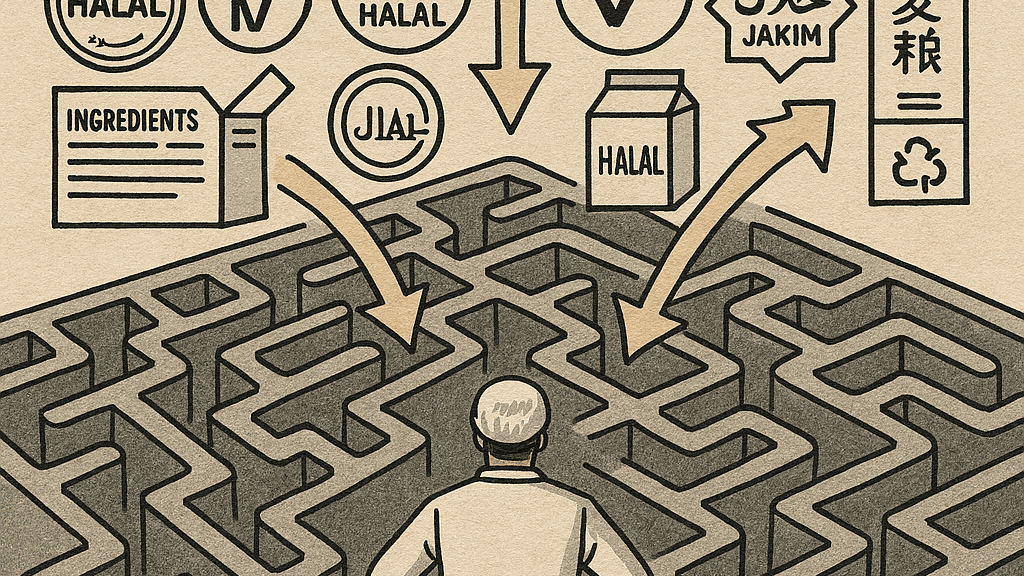
The Core Challenge: A Fragmented Global Standard
One of the most significant hurdles for international manufacturers is the absence of a single, universally accepted halal standard. While organizations like the Standards and Metrology Institute for Islamic Countries (SMIIC) have attempted to harmonize standards among the 57 member states of the Organization of Islamic Cooperation (OIC), implementation remains inconsistent.
In practice, halal certification is highly localized. Each country operates under its own religious authority, legal framework, and interpretation of Islamic law. As one industry analysis notes, 'Each nation is now following its own standards, regulatory authorities, and labeling guidelines.' Consequently, a certificate recognized in Malaysia may face rejection or require supplementary documentation in Indonesia or the Gulf States. This fragmentation forces manufacturers to treat halal compliance as a multi-jurisdictional regulatory exercise rather than a single checklist.
Divergent Religious Interpretations
The differences are not merely bureaucratic; they stem from varying schools of Islamic jurisprudence. Controversial technical issues include the permissibility of stunning animals before slaughter, the role of non-Muslim slaughterers, and the classification of aquatic animals and insects. For example, while most Gulf standards permit stunning under specific conditions, Pakistan's standards historically take a stricter stance. Such nuances mean that a production line approved for one market might technically violate the standards of another, requiring manufacturers to segregate supply chains.
Middle East: Standardization under the GSO Umbrella
The Middle East represents a highly lucrative but strictly regulated market. The Gulf Cooperation Council (GCC) countries—including Saudi Arabia, UAE, Qatar, and Kuwait—have made significant strides in harmonizing their standards under the GSO 2055-1:2015 and GSO 2055-2:2015 frameworks.
Recognition of Certificates
The Middle East is generally more open to accepting international halal certification bodies (HCBs), provided they are approved by local authorities. For instance, the UAE operates a system where the Emirates International Accreditation Centre (EIAC) accredits foreign HCBs under the supervision of the Ministry of Industry and Advanced Technology (MOIAT). Similarly, Qatar mandates that certificates be issued by 'Qatar-approved foreign certifiers' under the Ministry of Public Health.
However, acceptance is not automatic. The Saudi Food and Drug Authority (SFDA) strictly controls which logos appear on packaging. Logos must be SFDA-approved, and non-compliant symbols can lead to a shipment being rejected at the border.
Halal Assurance Systems
Middle Eastern regulators demand rigorous traceability. The supply chain must maintain complete segregation of halal products from non-halal products, covering storage, transportation, and processing. Audits are extensive and often unannounced, focusing on preventing cross-contamination with pork or alcohol-based processing aids.
Logo and Packaging Usage
The Middle East is highly sensitive to cultural and religious symbolism. Qatar explicitly prohibits the trading of goods bearing logos, symbols, or expressions that 'do not comply with the teachings of the Islamic religion' or violate common decency. Even imagery that is innocuous in Western markets (such as crosses, certain 'indecent' animal depictions, or references to gambling/alcohol) can result in the seizure of goods and fines up to one million Qatari riyals.
Upcoming Challenges
While standardization exists, manufacturers exporting to both the GCC and non-GCC Middle Eastern nations (like Iran) must still navigate variations. Furthermore, there is a growing demand for 'Halal + Tayyib' (Pure/Wholesome), pushing manufacturers to ensure not just religious compliance but also ethical and hygienic superiority.
South Asia: Diverging Paths of Pakistan, India, and Bangladesh
South Asia presents a mixed landscape. While Pakistan has a centralized national standard, India operates through a multitude of private certifiers, and Bangladesh is rapidly developing its infrastructure.
Recognition of Certificates
Pakistan is the most structured in this region. The Pakistan Halal Authority (PHA) oversees certification under PS: 3733-2016, making certification mandatory for food exports to GCC countries, Malaysia, and Indonesia. For a foreign manufacturer to export halal products to Pakistan, their certificate must be endorsed by the PHA or a body accredited by the Pakistan National Accreditation Council (PNAC).
In contrast, India lacks a single government-mandated halal authority for exports, relying instead on bodies like Jamiat Ulama-i-Hind Halal Trust or Halal India. While these are accepted in many Gulf nations, they face intense political and regulatory scrutiny, particularly regarding non-food items, and may not be automatically accepted in markets like Indonesia.
Halal Assurance Systems
South Asian buyers (and regulatory bodies for imports) require strict documentation of ingredient origins. A major challenge here is the verification of gelatin (E441), glycerin (E422), and emulsifiers (E471). Pakistan requires specific certification that these ingredients are derived from halal-slaughtered animals or plant sources, rejecting 'animal origin unknown''statuses.
Upcoming Challenges
The primary challenge in South Asia is the inconsistency in enforcement. While Pakistan is moving toward mandatory certification for domestic products (similar to Indonesia), India remains voluntary. However, with the rise of Muslim-conscious consumers globally, retailers in the Middle East are increasingly demanding that South Asian-origin products carry higher-tier certifications (e.g., JAKIM recognition) rather than local ones.
Far East Asia: The Looming 2026 Deadline
The Far East (ASEAN region) is currently the epicenter of halal regulatory evolution. The dynamics are shifting from 'voluntary' to 'mandatory,' with Indonesia leading the charge.
Indonesia: The Game Changer
Indonesia is implementing the most aggressive halal mandate in the world. By October 17, 2026, all food and beverage products circulating in Indonesia—local or imported—must be halal-certified.
- Recognition of Certificates: Foreign halal certificates are no longer automatically accepted. The Badan Penyelenggara Jaminan Produk Halal (BPJPH) requires that foreign HCBs be accredited by BPJPH. Manufacturers must either use a locally recognized foreign body (like the American Halal Foundation) or have their certification audited for equivalency by the Indonesian authorities.
- Halal Assurance Systems: Indonesia mandates a Halal Product Assurance System (SJPH). This is a quality management system approach requiring documented traceability from raw material sourcing to delivery. The 2026 deadline is forcing manufacturers to scrutinize 'invisible' ingredients like food colors. Carriers and emulsifiers (e.g., mono- and diglycerides) that may be derived from animal fats are now a major compliance risk. If a color system uses an animal-derived carrier, the entire product is non-halal.
- Logo Usage: Indonesia has strict rules regarding the halal logo. The logo must be accompanied by the certification number, and the MUI (Indonesian Ulema Council) label is being phased into the national BPJPH logo.
Malaysia, Singapore, and Thailand
- Malaysia (JAKIM): Still the gold standard. JAKIM (Department of Islamic Development Malaysia) is arguably the most respected certifier globally. They follow MS 1500:2019 and require stringent audits. However, JAKIM does not automatically recognize other bodies; foreign certifiers must apply for 'Foreign Halal Certification Body Recognition.' Malaysia is also a major re-export hub, meaning goods passing through must have JAKIM approval or acceptance.
- Singapore (MUIS): MUIS (Majlis Ugama Islam Singapura) is a highly efficient, government-linked regulator. They offer specific schemes for products (PRO), whole plants (WP), and endorsements. Singapore accepts foreign certificates under the 'Endorsement Scheme' but charges fees per consignment (e.g., S$288 for import endorsement).
- Thailand (CICOT): The Central Islamic Council of Thailand (CICOT) is the sole authorized body. They follow OIC/SMIIC standards, making Thai certification widely accepted in the Middle East.
Upcoming Challenges for Far East
The October 2026 deadline is the immediate crisis. Beyond Indonesia, there is a 'domino effect.' As Indonesia mandates certification, neighboring countries like the Philippines (Mindanao region) and Vietnam are increasing enforcement to attract investment. Furthermore, the Indonesian government is actively pushing for international harmonization to position itself as the global halal leader, which could eventually force other nations to align with BPJPH standards rather than JAKIM.
Another specific challenge is the scrutiny of food colors. As noted by industry experts, 'manufacturers can no longer assume that 'natural' or 'approved' automatically means halal-ready.' By 2026, every additive, including color carriers and processing aids (like alcohol-based solvents for extracts), must be certified.
Comparative Analysis: Key Differences
To effectively strategize, manufacturers must understand the granular differences summarized below:
| Feature | Middle East (GCC) | South Asia (Pakistan) | Far East (ASEAN) |
|---|---|---|---|
| Governing Standard | GSO 2055-1:2015 | PS: 3733-2016 | MS 1500:2019 (MYS), BPJPH (IDN) |
| Certificate Recognition | Open to accredited foreign bodies; requires local embassy/consulate approval often. | Centralized under PHA; strict approval for imports. | Indonesia: Must be BPJPH-accredited. Malaysia: JAKIM recognition required. |
| Critical Compliance Risk | Symbolism on packaging; stunning methods. | Gelatin and animal-derived enzymes. | Supply chain segregation; additive carriers (E471, E422). |
| Mandate Status | Mandatory for specific meat/poultry imports. | Mandatory for exports to specific regions. | Mandatory for all products by Oct 2026 (Ind). |
| Logo Rules | SFDA approved logos; no religiously offensive imagery. | Specific labeling controls for traceability. | Specific font, size, placement rules; certification number must be visible. |
Strategic Recommendations for Manufacturers
Given the fragmentation, a 'one-size-fits-all' halal strategy is likely to fail. Here is a roadmap for navigating these challenges:
- Adopt a 'System' Mindset, Not Just a Certificate: Move beyond simply slapping a logo on a box. Implement a Halal Assurance System (HAS) similar to ISO 22000, where raw material sourcing (especially additives and processing aids) is documented and verified at every stage. As one supplier noted, 'every certified product is only as compliant as its least-transparent input.'
- Prioritize the 2026 Indonesia Deadline: If you export to or plan to export to Indonesia, treat the October 2026 deadline as a non-negotiable cut-off. Begin the BPJPH accreditation process for your foreign certifier now. Audit your supply chain for 'doubtful' ingredients—particularly glycerin, emulsifiers, and natural colors that might use non-halal carriers.
- Map Certificate Recognition Routes: Do not assume a Malaysian JAKIM approved certificate will clear customs in Jakarta. Verify mutual recognition agreements (MRAs). If none exist, you may need dual certification (e.g., local JAKIM for Malaysia and a BPJPH-recognized certifier for Indonesia). So it is a safe bet to find a certifier who is recognized in both countries.
- Review Packaging for Cultural Compliance: For the Middle East, your legal team must review packaging for visual compliance. Remove any imagery of pigs, dogs, crosses, 'adult' content, or references to gambling. In Qatar, this is a strict legal requirement under Consumer Protection Law No. 8 of 2008.
- Integrate Halal with Other Certifications: To save costs and time, look for HCBs that offer integrated audits. It is possible to bundle halal certification with Vegan, Non-GMO, and Gluten-Free audits, streamlining the process and reducing operational disruption.
In conclusion, while the global halal market offers immense opportunity, the regulatory landscape is a complex patchwork of sovereign requirements. The era of treating halal as a simple sticker is over. Success in 2025 and beyond will belong to manufacturers who treat halal compliance as a sophisticated, data-driven component of their global supply chain management.
Jabatan Kemajuan Islam Malaysia (JAKIM)Badan Penyelenggara Jaminan Produk Halal (BPJPH)
SFDA - هيئة الغذاء والدواء
Majlis Ugama Islam Singapura
HalalFocus

Office Locations
Halal Certification Services (HCS) certifies companies all over the world. Our locally-based auditors can speak and assist in your local languages. Find the contact details of our offices nearest to you as mentioned below: