Indonesia's BPJPH Halal Supervisor Requirement: A Comprehensive Analysis of Compliance Challenges and Cost Implications for Exporters- October 01, 2026
As Indonesia's mandatory halal certification deadline of 17 October 2026 approaches, the Halal Product Assurance Agency (BPJPH) is building a complete compliance framework.
Introduction
As Indonesia's mandatory halal certification deadline of 17 October 2026 approaches, the Halal Product Assurance Agency (BPJPH) is building a complete compliance framework. Central to this framework is the Halal Supervisor (Penyelia Halal) system—which applies not only to Indonesian domestic companies but also mandates that foreign companies must have a qualified supervisor when applying for halal certification.
On 28 August 2026, Indonesia submitted Notification G/TBT/N/IDN/193 to the WTO/TBT Committee, seeking public comment on the Draft Regulation on Halal Supervisors. The draft comprises ten chapters and twenty-eight articles, systematically setting out the qualification requirements, duties and authorities, registration procedures, and supervision mechanisms for supervisors, covering food, beverages, pharmaceuticals, cosmetics, and other product sectors. For Swiss manufacturers planning to export products to Indonesia, understanding this system is not only about compliance costs—it directly affects product competitiveness in the Indonesian market.
Part 1: Legal Framework and Core Positioning of the Halal Supervisor
1.1 Legal Basis
The legal foundation for the Halal Supervisor system derives primarily from Law No. 33 of 2014 on Halal Product Assurance (UU JPH) and Government Regulation No. 42 of 2024 (GR 42/2024). Under Article 65 of GR 42/2024, business actors applying for a halal certificate must have a halal supervisor.
Before the new regulation was introduced in August 2026, halal supervisor requirements were scattered across multiple regulatory documents without a unified management framework. BPJPH's purpose in drafting a dedicated regulation is to establish a unified and clear management system covering all categories of business actors, including foreign companies.
1.2 Definition and Positioning of the Halal Supervisor
A halal supervisor is a person within the company responsible for ensuring that the entire production process complies with the Halal Product Assurance System (SJPH). Unlike a Halal Auditor—who is dispatched by an external body to conduct independent audits—the supervisor is the company's own "internal gatekeeper," responsible for day-to-day compliance monitoring, risk management, and corrective actions.
According to the regulation, the supervisor's main duties include:
- Supervising the company's internal Halal Product Process (PPH)
- Determining corrective and preventive measures
- Coordinating PPH-related activities and accompanying the halal auditor during audits
The supervisor's authorities include: accessing all information and documents related to SJPH implementation, conducting internal audits and management reviews, recommending suspension of operations when non-conformities that may affect product halal status are found, controlling material approval, requesting explanations from relevant parties, and coordinating laboratory testing.
Part 2: Qualification Requirements and Training System to Become a Halal Supervisor
2.1 Basic Qualification Requirements
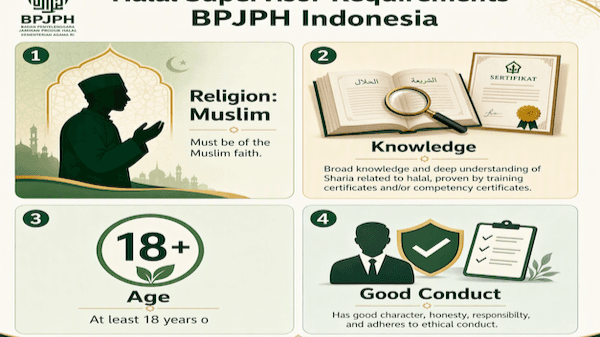
Under Article 17 of the draft regulation, halal supervisors in all categories must meet the following basic conditions:
Requirement Details
Religion Muslim
Knowledge Broad knowledge and deep understanding of Sharia related to halal, proven by training certificates and/or competency certificates
Age At least 18 years old
Identity Indonesian residents must provide KTP (identity card); foreign supervisors must provide passport, residence permit, etc.
Notably, Indonesian law imposes no nationality restriction on halal supervisors. Article 64 of GR 42/2024 explicitly provides that foreign nationals may serve as halal supervisors, requiring only a passport, residence permit, and other identity documents. This means Swiss manufacturers can develop or hire qualified personnel as supervisors themselves, without relying on Indonesian nationals.
2.2 Training Requirements
Halal supervisor training is delivered by BPJPH, higher education institutions, and other training institutions recognized by BPJPH. Under Articles 61–63 of GR 42/2024, the training mechanism, procedures, standards, and competency requirements are further stipulated by Ministerial Decree.
Training covers both theoretical and practical aspects:
- Theory: SJPH principles, critical control points, relevant regulations, SiHalal system operation, material analysis, etc.
- Practice: Practical exercises in SJPH implementation
Participants who complete the training receive a Training Completion Certificate (STTP) and a Halal Supervisor Competency Certificate. For medium and large enterprises and foreign companies, both certificates are required; for micro and small enterprises, only the training certificate is needed.
2.3 BPJPH-Recognized Training Institutions
BPJPH maintains an official list of recognized training institutions on its website, currently including:
| Category | Example Institutions |
|---|---|
| University Halal Centers | UIN Sunan Kalijaga Yogyakarta, IPB Halal Science Center, Universitas Trunojoyo Madura |
| Professional Training Institutions | Indonesia Halal Training & Education Center (IHATEC), Halal Institute |
| Government Training Institutions | Balai Diklat Industri Jakarta, Balai Diklat Industri Makassar |
| Industry Associations | Badan Pendidikan dan Pelatihan Ikatan Apoteker Indonesia |
In addition, halal centers at several universities offer halal supervisor training programs, including Universitas Negeri Padang (UNP) and UIN Syarif Hidayatullah Jakarta. UNP's training starts from IDR 700,000 (approximately USD 45), aimed at UMK (micro and small enterprises). UIN Jakarta's LPSDMH offers both online and offline training modes, serving domestic and international companies.
2.4 Estimated Costs
Official Registration Fee: The draft regulation does not specify the exact registration fee amount but provides that it must be paid within 5 working days of invoice issuance. With reference to BPJPH's existing fee structure, halal certification-related service fees typically range from several hundred thousand to several million Indonesian Rupiah.
Training Costs: Training costs vary by institution and mode. Based on publicly available information:
- UNP training: From IDR 700,000 (approximately USD 45), for UMK
- Some training programs are free: For example, P3H training programs at UIN Malang and UNSOED are explicitly marked "GRATIS" (free)
- Private training institutions: Costs may be higher; inquire directly
Hidden Costs:
- Personnel time cost: The supervisor must invest time in daily supervision, internal audits, and management reviews
- Ongoing training cost: The supervisor may need to periodically update knowledge and skills
- System operation cost: Use and management of the SiHalal system
Part 3: Registration Process and Cost Overview
3.1 SiHalal System Registration Process
Under the draft regulation, halal supervisors must register with BPJPH through the SIHALAL electronic system. The registration process is as follows:
Step 1: Submit Registration Materials
Required materials include:
- Identity documents (Indonesian residents: KTP; foreign nationals: passport and residence permit)
- Curriculum Vitae (CV)
- Training certificate and/or competency certificate
- Employment agreement
- Proof of residence
- Recent photograph
Step 2: BPJPH Document Review
BPJPH completes document review within 5 working days.
Step 3: Pay Registration Fee
After review approval, BPJPH issues an invoice. The registration fee must be paid within 5 working days of invoice issuance, extendable twice.
Step 4: Obtain Registration Number
Within 2 working days after payment confirmation, BPJPH issues the registration number.
3.2 Process for Companies Designating a Supervisor
Under Article 64 of GR 42/2024, company management must notify BPJPH of the designated halal supervisor, attaching relevant documents:
- Supervisor residing in Indonesia: Copy of KTP
- Foreign supervisor: Copy of passport, residence permit, and other identity documents
- CV
- Halal supervisor training certificate and/or competency certificate
- Copy of supervisor appointment decision
Part 4: Challenges and Impact on Export Manufacturers
4.1 Mandatory Supervisor Requirement
For foreign manufacturers exporting to Indonesia, the most direct challenge is: they must have a BPJPH-compliant halal supervisor. This means:
Personnel allocation issue: Swiss manufacturers need to designate a Muslim employee within the company as a halal supervisor, or hire a qualified person externally. That person must complete BPJPH-recognized training and obtain the relevant certificate.
Training accessibility issue: Although some training institutions offer online training, the content is primarily in Indonesian and involves Indonesian halal regulations and SiHalal system operation. For Swiss companies unfamiliar with Indonesia's regulatory system, this constitutes an additional learning barrier.
Ongoing compliance obligation: The supervisor is not merely a "certificate holder" but bears ongoing supervisory responsibility. Under the regulation, the supervisor must:
- Conduct internal audits and management reviews
- Determine corrective and preventive measures
- Have the authority to recommend suspension of operations when non-conformities are found
- Coordinate laboratory testing
- Accompany auditors during external audits
This means companies must provide the supervisor with sufficient authority and resources to effectively perform their duties.
4.2 Timeliness Requirements for Supervisor Registration
The time limits in the registration process pose practical challenges for exporting companies:
- Document review: 5 working days
- Payment deadline: 5 working days from invoice issuance (extendable twice)
- Registration number issuance: 2 working days after payment confirmation
Although the total duration could theoretically be completed within two weeks, in practice it may be extended by incomplete documents, translation issues, or system delays. For companies with existing export plans, this can create time pressure.
4.3 The "Four-Year Rule" and Replacement Mechanism
The draft regulation establishes a strict continuity requirement: if a halal supervisor is not designated by any company for four consecutive years, BPJPH will revoke their registration number, and they may not re-register thereafter.
The implication for companies is that if they replace a supervisor, the former supervisor's registration number becomes invalid, and the company must ensure the new supervisor can register smoothly. Companies may replace supervisors under specific circumstances, including: failure to meet qualification requirements, violation of JPH regulations, disclosure of trade secrets, resignation, contract expiration, management decision, or death of the supervisor.
4.4 Transitional Arrangements
For halal supervisors already designated before the regulation takes effect, Article 27 of the draft provides that they continue to be recognized, but must complete compliance adjustments within two years of the effective date. This provides a buffer period for existing companies, but new exporters must ensure compliance from the outset.
Part 5: Cost Impact and Product Competitiveness Analysis
5.1 Direct Compliance Costs
Training costs: As noted, training costs range from free to several million Indonesian Rupiah. For companies requiring foreign personnel to attend training, travel, accommodation, and translation costs must also be considered.
Registration costs: The official registration fee amount is not yet specified but is expected to be within an acceptable range.
Personnel costs: If companies choose to develop internally, they must invest existing employee time and training resources. If hiring externally, they must bear recruitment and compensation costs.
5.2 Indirect and Operational Costs
Management time cost: The supervisor must invest substantial time in daily supervision, internal audits, and management reviews. For small and medium-sized enterprises, this may mean that part or all of an employee's workload is allocated to compliance matters.
System operation cost: Use and management of the SiHalal system requires training and time investment.
Risk of suspension: The supervisor has the authority to recommend suspension of operations when non-conformities are found. While this is a necessary mechanism for ensuring compliance, it also means production interruption risk—for time-sensitive products (such as fresh food), this can cause significant losses.
5.3 Impact on Product Competitiveness
High value-added products: For higher-priced products (such as Swiss chocolate, premium cosmetics), supervisor-related compliance costs can be absorbed by product margins, with relatively limited impact on competitiveness.
Commodity and price-sensitive products: For lower-priced, volume-driven products, compliance costs can significantly erode profit margins. For a product line with annual exports of USD 500,000, if supervisor-related costs (training, registration, personnel time) reach USD 5,000–10,000 per year, this represents a 1–2% cost increase. In highly price-competitive categories, this can be a decisive factor.
Disproportionate impact on SMEs: Large multinationals can spread compliance costs across multiple products and markets, while SMEs may face disproportionately high fixed costs. For SMEs entering the Indonesian market for the first time, the supervisor requirement can constitute an entry barrier.
Compliance as a differentiation advantage: On the other hand, having a compliant halal supervisor can serve as a signal of market trust. Indonesian consumers place extremely high importance on halal certification—a 2023 Populix survey found that 83% of respondents considered the halal logo a primary factor in product selection, rising to 93% for food products. For companies willing to invest in compliance, this can translate into brand premium and consumer loyalty.
Conclusion and Recommendations
BPJPH's halal supervisor system is a key component of Indonesia's effort to build a complete halal product assurance ecosystem. For Swiss manufacturers exporting to Indonesia, this system is both a compliance obligation and a market access threshold.
Key Takeaways:
- Mandatory requirement: All business actors applying for halal certification (including foreign companies) must have a halal supervisor
- Qualification conditions: Muslim, at least 18 years old, with halal knowledge (proven by training/competency certificate)
- Training channels: BPJPH-recognized training institutions, some offering online training, costs ranging from free to several million Indonesian Rupiah
- Registration process: Through the SiHalal system—5 days document review, 5 days payment, 2 days issuance
- Ongoing obligations: The supervisor must conduct internal audits and management reviews, and has the authority to recommend suspension of operations
- Cost impact: Direct costs are manageable, but indirect costs (personnel time, management burden) have a greater impact on SMEs
Recommendations for Exporting Companies:
- Start compliance preparation early: Do not wait until close to the export date to arrange supervisor training and registration
- Assess internal resources: Check whether there are already qualified Muslim employees who can be developed as supervisors
- Consider external support: If internal resources are insufficient, consult BPJPH-recognized training institutions or professional advisors
- Incorporate compliance costs into pricing: When developing pricing strategies for the Indonesian market, fully consider the ongoing costs associated with the supervisor
- Leverage compliance advantage: Use the halal supervisor system as a quality assurance and consumer trust marketing point
As the 17 October 2026 deadline approaches, Indonesia's halal regulatory framework will become increasingly stringent. For exporting companies serious about the Indonesian market, proactive compliance is not only a legal requirement but a strategic investment in building long-term competitive advantage.
Badan Penyelenggara Jaminan Produk Halal (BPJPH)SwissCham Indonesia
Embassy of Switzerland in Indonesia
Swiss Business Hub Southeast Asia + Pacific
EKONID (AHK Indonesien)

Office Locations
Halal Certification Services (HCS) certifies companies all over the world. Our locally-based auditors can speak and assist in your local languages. Find the contact details of our offices nearest to you as mentioned below: