How New Halal Requirements in Indonesia, Türkiye, Saudi Arabia, Algeria, and Vietnam Are Reshaping Export Markets- October 14, 2026
A new wave of halal regulatory reform is sweeping across key Muslim-majority markets, fundamentally altering the compliance landscape for food, beverage, cosmetic, and pharmaceutical exporters. From Indonesia's mandatory pre-shipment inspection regime to Saudi Arabia's digital certification platform, these changes represent a shift from voluntary certification to mandatory, supply-chain-wide verification.
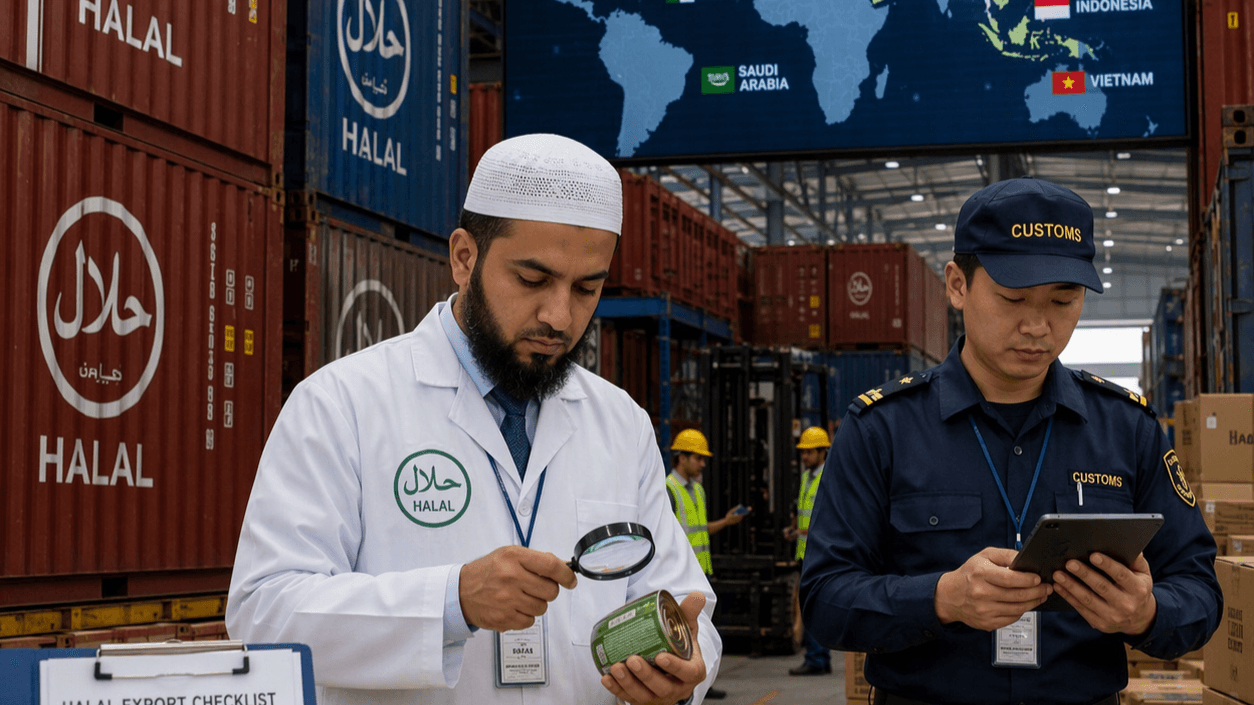
Introduction
A new wave of halal regulatory reform is sweeping across key Muslim-majority markets, fundamentally altering the compliance landscape for food, beverage, cosmetic, and pharmaceutical exporters. From Indonesia's mandatory pre-shipment inspection regime to Saudi Arabia's digital certification platform, these changes represent a shift from voluntary certification to mandatory, supply-chain-wide verification. For manufacturers in Europe, Asia, and the Americas, understanding these divergent regulatory frameworks is no longer optional—it is a prerequisite for market access.
This article examines the halal requirements introduced by Indonesia, Türkiye, Saudi Arabia, Algeria, and Vietnam, analyzes their practical implications for exporters, and assesses how these regulatory shifts are reshaping competitive dynamics in the global halal economy.
Indonesia: The Most Comprehensive Regulatory Overhaul
Indonesia, home to the world's largest Muslim population, has enacted the most sweeping halal regulatory transformation. BPJPH Regulation No. 4 of 2026, effective 9 September 2026, introduces mandatory pre-shipment conformity verification for imported products covered by Indonesia's halal assurance framework.
Under this regime, products must undergo document-based verification in the country of origin before shipment, conducted at the loading warehouse by BPJPH-appointed inspection bodies including Sucofindo, Surveyor Indonesia, Anindya, and Mutu Internasional. The inspection covers administrative document consistency, halal certificate validity, product packaging, HS code classification, production codes and dates, contamination risks, and supporting documents such as CoA, CoO, and MSDS.
The verification result is documented in a Laporan Pemastian Produk Halal (LPPH), which is valid for one shipment only and must be obtained before the importer submits the customs import declaration. Importers must apply through BPJPH's integrated electronic system, with the inspection body generally having 15 calendar days to complete assessment, extendable by another 15 days.
Indonesia has also introduced complementary regulations on non-halal labeling and administrative sanctions, creating a complete compliance architecture. Products containing pork must bear the label "MENGANDUNG BABI" (Contains Pork), while other non-halal products require a "NON HALAL" statement. Administrative sanctions range from written warnings to operational suspension and revocation of certification status.
Saudi Arabia: Digital Platform and Tiered Certification
Saudi Arabia's SFDA has implemented a dual-certificate system through its new digital platform, effective 1 October 2024. Exporters must now obtain both a Halal Facility Certificate (annual, SAR 3,750 or approximately EUR 900) and a Halal Batch Certificate (SAR 1,000 or approximately EUR 240 per shipment up to 27 tonnes).
The new platform requires registration of both facilities and products, with product names provided in both English and Arabic. All documents must be submitted in English and PDF format, including commercial register, free sale certificate, company profile, quality manual, GSO-certified quality management system documentation, test reports from ISO 17025 accredited laboratories, factory layout, product labels, Halal System Program, raw material certificates, and product composition reports.
A critical restriction applies to slaughtering and meat processing facilities: the halal certificate must be issued by a body accredited by SFDA and registered in the same country as the establishment. For other product categories, no cross-border restriction applies.
Türkiye: Voluntary Certification with Mandatory Import Controls
Türkiye's approach, articulated in Communiqué No. 2026/35, maintains halal certification as voluntary in principle. However, for certain imported products—including chocolate, confectionery, cereal products containing nuts, soy sauce, and gelatin—any halal mark on the product triggers mandatory certification requirements.
All import inspection procedures are conducted through the TAREKS system, Türkiye's risk-based trade control platform. Exporters must upload documentation related to all halal markings on products, and physical inspection verifies that packaging markings comply with the Halal Act. Successful inspection generates a TAREKS reference number valid for one year.
If inspection determines non-compliance, the product cannot be imported with halal certification unless the halal declarations are removed from the product or packaging in a manner deemed appropriate by inspection authorities.
Algeria: Clarified Certification Requirements and Expanded Product Scope
Algeria's halal regime has evolved significantly, with a June 2024 clarification resolving confusion about certification requirements. The Algerian government confirmed that the Grand Mosque of Paris (GMP) certification mandate applies only to products originating from France or European markets where GMP operates. All other markets must ensure certification by appropriate halal certifying bodies in their respective countries.
Algeria has expanded the list of products subject to mandatory halal certification to include:
- Meat and animal-origin products
- Animal oils and fats
- Confectionery including chocolate, pastries, and biscuits
- Food additives of animal origin
- Dairy derivatives including caseinates
- All cheeses intended for processing or food industry
- Infant formulas and follow-on formulas
- Rennet
The National Committee for Halal Certification, chaired by the Ministry of Commerce, continues to update requirements and the roster of products subject to certification.
Vietnam: First Comprehensive Legal Framework
Vietnam has taken a significant step with Decree No. 127/2026/ND-CP, the country's first comprehensive legal framework for the halal sector, effective 15 May 2026. The decree covers halal products and services, including accommodation, catering, travel, and transportation for Muslim tourists.
A key principle is transparency and traceability throughout the supply chain. Ingredients must comply with halal requirements, animal-derived ingredients must come from halal-slaughtered animals, and production, processing, packaging, storage, and transport must prevent cross-contamination with non-halal ingredients.
Halal certification remains voluntary based on business needs, except where specific laws provide otherwise. However, certification bodies operating in Vietnam must meet capacity requirements, including at least two officially certified Muslim experts with university degrees and specialized halal assessment training.
Vietnam is actively pursuing mutual recognition agreements and harmonization with international standards including OIC, SMIIC, and Codex Alimentarius. The government has also committed to establishing a national halal database and providing financial support for businesses participating in international trade promotion.
Comparative Analysis: Divergent Regulatory Philosophies
| Country | Certification Status | Key Mechanism | Cost Structure |
|---|---|---|---|
| Indonesia | Mandatory (phased) | Pre-shipment inspection (LPPH) | LPPH per shipment; inspection body fees |
| Saudi Arabia | Mandatory | Facility + batch certificates via SFDA platform | SAR 3,750 facility/year; SAR 1,000 batch/shipment |
| Türkiye | Voluntary but conditional for marked products | TAREKS import inspection | TAREKS reference number (1 year validity) |
| Algeria | Mandatory for listed products | Only GMP certificates | €1,000/company; €0.10/kg certified product |
| Vietnam | Voluntary | Decree 127 framework; MRA promotion | Government support; no fixed fee schedule |
Practical Implications for Exporters
1. Compliance Timelines Must Be Recalibrated
Indonesia's pre-shipment inspection requirement adds 45–60 days to the export process before goods can even leave the origin country. Exporters must integrate this lead time into production and logistics planning.
2. Documentation Consistency Is Critical
Across all five markets, the emphasis on document-product consistency is unprecedented. Indonesia's inspection specifically verifies that halal certificate numbers on packaging match registered certificates, that HS codes align with Indonesia's positive list, and that production codes and dates match purchase invoices. Saudi Arabia requires all documents in English and PDF, with product names in both English and Arabic.
3. Mutual Recognition Agreements Are Essential
Indonesia has signed MRAs with over 100 foreign halal certification bodies across 6 continents, and continues expanding this network with agreements signed with the Philippines, Mexico, China, Morocco, and South Korea. Exporters must verify that their certifier is on BPJPH's recognized list, as certificates from non-MRA bodies will not be accepted.
4. Country-of-Origin Restrictions Apply in Specific Sectors
Saudi Arabia requires that halal certificates for slaughtering and meat processing facilities be issued by a body registered in the same country as the establishment. This creates a "country-of-production" rule that fragments certification requirements for multinational manufacturers.
5. Digital Platforms Are Becoming the Standard
Saudi Arabia's SFDA platform, Indonesia's SIHALAL system, and Türkiye's TAREKS application represent a broader shift toward digital-first regulatory compliance. Exporters must be prepared to navigate multiple electronic systems, each with its own registration, documentation, and verification requirements.
Cost Impact and Competitiveness
The cumulative cost impact varies significantly by product category and shipment size:
- High-value products (premium chocolate, specialty cosmetics): Compliance costs of 2–5% of shipment value may be absorbable within margins, particularly where halal certification enables premium positioning.
- Medium and low-value products (processed foods, ingredients): With compliance costs potentially reaching 5–10% of shipment value, margins face significant compression. Saudi Arabia's batch certificate fee of SAR 1,000 (approximately EUR 240) per shipment is particularly impactful for smaller consignments.
- SMEs and first-time exporters: Fixed compliance costs—certification body fees, documentation preparation, potential travel for inspections—create disproportionate barriers. Indonesia's pre-shipment inspection requirement adds logistical complexity that may prove prohibitive for smaller exporters.
Strategic Recommendations for Exporters
- Map your product portfolio against each market's mandatory certification scope
- Verify MRA status of your halal certifier for Indonesia, and country-of-origin requirements for Saudi Arabia
- Build extended lead times into supply chain planning, particularly for Indonesian pre-shipment inspection
- Standardize documentation across markets where possible, while ensuring country-specific compliance
- Consider regional certification hubs—a certifier recognized in multiple MRA jurisdictions can reduce duplication
- Monitor regulatory evolution—Indonesia's framework is still maturing, and implementing guidelines for non-halal products remain under development
Conclusion
The new halal requirements across Indonesia, Türkiye, Saudi Arabia, Algeria, and Vietnam reflect a fundamental shift in how Muslim-majority markets govern food, beverage, and consumer product safety. Certification is no longer merely a labeling exercise—it encompasses pre-shipment verification, supply chain traceability, digital platform registration, and ongoing compliance obligations.
For exporters, this regulatory fragmentation creates both challenges and opportunities. The compliance burden is real, particularly for SMEs and price-sensitive product categories. Yet for manufacturers willing to invest in robust halal assurance systems, these requirements can serve as a competitive moat—signaling quality, trustworthiness, and commitment to the world's fastest-growing consumer segment.

Office Locations
Halal Certification Services (HCS) certifies companies all over the world. Our locally-based auditors can speak and assist in your local languages. Find the contact details of our offices nearest to you as mentioned below: