The 'Sunk Cost' of BPJPH-Certified Companies and the 2028 Extension: A Compliance Marathon Without Exemption- October 19, 2026
Jakarta — On 16 October 2026, the Indonesian government announced an extension of the mandatory halal certification deadline from October 2026 to October 2028.
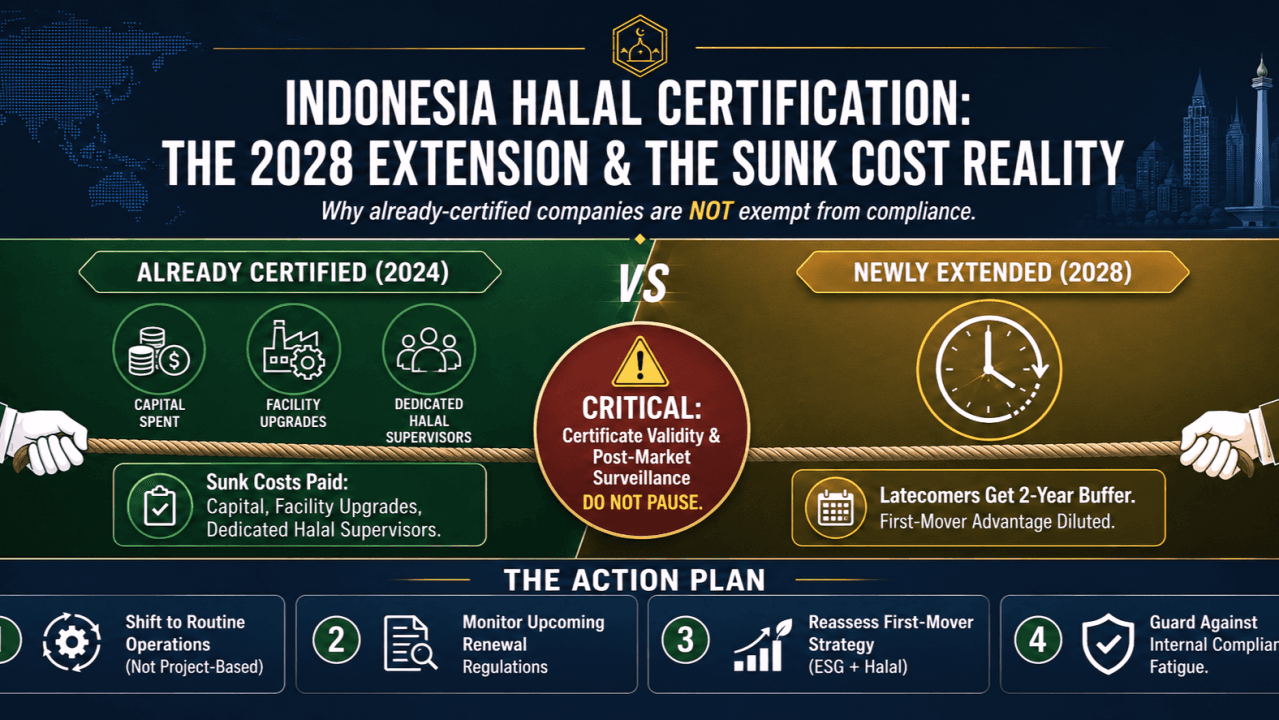
Jakarta — On 16 October 2026, the Indonesian government announced an extension of the mandatory halal certification deadline from October 2026 to October 2028. For companies that have not yet begun the certification process, this is undoubtedly a breathing space. However, for companies that have already invested money, manpower, and time to obtain BPJPH halal certificates, this policy adjustment brings not relief, but a subtle predicament: they paid compliance costs early, yet now stand at the same 2028 starting line as latecomers.
More critically, the extension has not changed one core fact: the validity of certified companies' certificates and their ongoing compliance obligations remain subject to no relaxation whatsoever.
What Certified Companies Have Already Paid
Economic Costs: Ranging from Hundreds of Thousands to Tens of Millions of Rupiah
The cost of Indonesian halal certification varies significantly depending on company size and product complexity. According to data published by LPPOM, regular certification costs for medium-sized enterprises range from approximately 2 million to 5 million rupiah, while large enterprises may exceed 10 million rupiah. BPJPH's official cost estimates are more specific: for food and beverage categories in Central Jakarta, for example, certification estimates for large enterprises can reach 30.21 million rupiah, medium enterprises approximately 22.23 million rupiah, and small enterprises approximately 2.56 million rupiah. Within the cost structure, LPH product inspection accounts for the largest share, at 59% to 88% of total costs.
For medium and large food and beverage enterprises that were already subject to mandatory requirements in October 2024, this expenditure has long since occurred. They not only paid the certification fees themselves but may also have borne hidden costs such as production line modifications, supplier changes, and dedicated storage facility construction to meet halal standards. These investments were accelerated under the pressure of the 2024 deadline, and now they see latecomers granted an additional two-year preparation window.
Human Resources and Organizational Costs: The Continuous Operation of the Halal Assurance System
Obtaining a certificate is only the starting point. Companies must maintain the daily operation of the Halal Product Assurance System (SJPH) , including staffing an internal halal supervisor (Penyelia Halal), maintaining raw material traceability records, and ensuring no cross-contamination during production. These positions and processes represent ongoing organizational overhead, not one-time expenditures.
In addition, certified companies must pay attention to certificate renewal and change management. Under current regulations, certificates remain valid as long as ingredients or production processes are unchanged, but once changes occur, companies must report to BPJPH and may trigger a re-certification procedure. The draft Halal Certificate Renewal Regulation circulated in July 2026 further refined the procedures requiring renewal due to ingredient changes, process changes, or product development, and mandated submission through an integrated electronic system. This means that certified companies' compliance teams need to continuously track regulatory changes—a daily function that cannot be cut simply because the deadline has been postponed.
The Practical Impact of the Extension: Not a "Sigh of Relief"
Changes in the Competitive Landscape
Certified companies may have already used the halal logo as a differentiating selling point in their marketing over the past two years. The extension means that competitors gain a two-year buffer period and can continue selling without certification pressure. For companies that took the lead in investing in compliance, this dilutes their first-mover advantage to some extent. This is particularly true in categories deferred to 2028—such as cosmetics, health supplements, and consumer electronics—where companies that proactively completed certification will face an awkward situation: compliance investments have already been sunk, but the market-side "halal premium" is postponed.
Uncertainty Brought by the Shift in Regulatory Attention
Alongside the extension announcement, BPJPH also revoked BPJPH Regulation No. 4/2026 (concerning pre-shipment inspection requirements for halal conformity of imported products). This series of actions indicates that regulatory resources are being redirected toward the vast number of uncertified enterprises—particularly MSEs and importers. For certified companies, this means that before 2028, the attention and support they receive from regulators may relatively decrease, and the processing efficiency of routine matters such as renewals and changes may be affected.
Certificate Validity and Compliance Inspections Will Not Pause
It bears repeating: the legal obligations for product categories already subject to mandatory requirements in 2024 have not changed in any way. BPJPH and LPH post-market surveillance will not stop because of the deadline extension. If certified companies relax their maintenance of SJPH and are found to have non-conformities during spot checks, they still face the risk of certificate suspension or revocation. LPPOM Chair Muti Arintawati's statement following the policy announcement also hinted at this: she urged companies not to treat the extra time as an excuse for delay and emphasized that halal certification should be viewed as "an effort to build consumer trust and ensure business sustainability," rather than a mere administrative obligation.
What Certified Companies Still Need to Do
First, shift compliance maintenance from a "project-based" approach to "routine operations." Certification is not a one-time project. Companies should ensure the stability of the halal supervisor position, regularly re-audit raw material suppliers, and establish internal self-inspection mechanisms to respond to possible unannounced inspections. During the extended period, regulators have more time to conduct random spot checks rather than focusing solely on new applications.
Second, closely monitor the formal implementation of the renewal regulation. The comment period for the draft renewal regulation circulated in July 2026 ended in September, and the formal regulation's publication is only a matter of time. Certified companies—especially those in cosmetics and health supplements with broader product lines and faster update cycles—need to map out in advance which SKUs may trigger renewal conditions and plan submission timing to avoid certificate gaps.
Third, reassess the strategic value of "first-mover advantage." Now that the market-side differentiation window has been stretched, companies can consider combining halal compliance with broader ESG narratives or product quality narratives, rather than relying solely on the halal logo itself. For export-oriented companies, BPJPH-recognized certificates still hold value when seeking mutual recognition with markets such as Malaysia and the Gulf states—a strategic dimension that should not be overlooked simply because the domestic deadline has been postponed.
Fourth, guard against internal complacency caused by "regulatory fatigue." The greatest risk of an extension lies not externally but within the organization. When the deadline shifts from "imminent" to "two years away," management attention to halal compliance may decline, budgets may be cut, and responsible teams may be reassigned. Certified companies need to be clear: the cost of maintaining a certificate is fixed, and the consequence of cutting maintenance investment is that already-sunk costs are completely written off.
Conclusion
The 2028 extension is a policy buffer designed for "those not yet ready," not a reward for "those already ready." For companies already holding BPJPH certificates, the accounting needs to be clear: the investment has already been made, the obligations have not been reduced, and the competitive window is narrowing. The truly rational response is not to complain about the time gap, but to ensure that during these two years, they do not become the cautionary tale featured in a spot-check bulletin—after all, in matters of halal compliance, losing a certificate happens far faster than obtaining one.

Office Locations
Halal Certification Services (HCS) certifies companies all over the world. Our locally-based auditors can speak and assist in your local languages. Find the contact details of our offices nearest to you as mentioned below: