BPJPH Regulation No. 3 of 2026: Indonesia's Mandatory Non-Halal Statement Regime- October 01, 2026
Indonesia's Halal Product Assurance Agency (Badan Penyelenggara Jaminan Produk Halal, BPJPH) enacted Regulation No. 3 of 2026 on the Form and Procedures for the Labelling of Non-Halal Information.
Introduction
On 13 July 2026, Indonesia's Halal Product Assurance Agency, Badan Penyelenggara Jaminan Produk Halal (BPJPH), enacted Regulation No. 3 of 2026 on the Form and Procedures for the Labelling of Non-Halal Information. The regulation entered into force on 23 July 2026, with a 12-month transitional period ending 23 July 2027.
This regulation is a significant shift in Indonesia's halal regulatory framework. While much attention has focused on the mandatory halal certification requirements, Regulation No. 3/2026 addresses the other side of the equation: products that cannot be certified halal because they originate from prohibited (haram) materials or are produced through non-halal processes. Rather than being banned from the market, such products are now required to carry a standardized Non-Halal Statement (Keterangan Tidak Halal, KTH).
For exporters to Indonesia—including Swiss manufacturers—this regulation creates a parallel compliance obligation. If a product contains pork, alcohol, or other prohibited substances, it must be labeled with the mandatory non-halal statement before it can be legally distributed in Indonesia.
Part 1: The Regulatory Framework and Its Rationale
1.1 Legal Basis
BPJPH Regulation No. 3/2026 implements Article 110 paragraph (3) of Government Regulation No. 42 of 2024, which mandates that products from prohibited materials be exempted from halal certification but required to carry a non-halal statement. The regulation provides the technical form, criteria, and procedures for affixing this statement.
The policy is grounded in Law No. 33 of 2014 on Halal Product Assurance (as amended), which establishes that Indonesia's halal regulatory system is not merely about certifying halal products—it is about ensuring transparency for all products, whether halal or not.
1.2 Policy Objective
According to BPJPH, the regulation aims to:
- Provide legal certainty for consumers, business actors, and authorities
- Ensure that products from prohibited materials are clearly identified in the market
- Protect consumers' right to accurate and non-misleading information
- Prevent consumer confusion about product halal status
As BPJPH Head Ahmad Haikal Hasan stated, "All non-halal products must carry a Non-Halal Statement in the form of an image or clear wording."
Part 2: Criteria for Non-Halal Statement
2.1 The Two Criteria
Under Article 4 of the regulation, the non-halal statement is required based on two criteria:
- Material Criteria (Kriteria Bahan)
- Production Process Criteria (Kriteria Proses Produksi)
These criteria reference materials and production processes that do not conform to the Halal Product Assurance System (Sistem Jaminan Produk Halal, SJPH).
2.2 Material Criteria in Detail
Article 5 categorizes materials that trigger the non-halal requirement:
Category Description
Animal origin Land animals that are forbidden, dangerous, amphibians, khabaits (repulsive animals), carrion, jallalah (animals that eat filth), protected animals, milk/eggs from forbidden animals
Plant origin Materials from plants that are prohibited
Contains alcohol Ethyl alcohol or ethanol (C₂H₅OH) that is intoxicating (khamr)
Microbial origin Materials produced by microorganisms that do not meet halal criteria
Chemical, biological, or genetic engineering Materials produced through these processes that do not conform to SJPH
Human body parts Any part of the human body
Impurities (najis or mutanajis) Materials that are ritually impure in Islamic law
Specific animals forbidden under Article 6–7 include:
- Pigs and dogs (classified as mughallazhah, severe impurity)
- Predatory animals with fangs (tigers, lions, bears, monkeys, cats, wolves, etc.)
- Predatory birds with talons (eagles, vultures, owls)
- Animals forbidden to be killed in Islam (woodpeckers, hoopoe birds, frogs, ants, honeybees)
- Carrion and jallalah animals
2.3 Production Process Criteria
The production process criteria consider how a product is processed, including locations, facilities, production equipment, and washing facilities used in processing, storage, packaging, distribution, and sale. If the production process does not meet SJPH requirements—for example, using equipment previously used for pork without proper ritual cleansing—the product must carry the non-halal statement.
Part 3: The Two Mandatory Label Designs
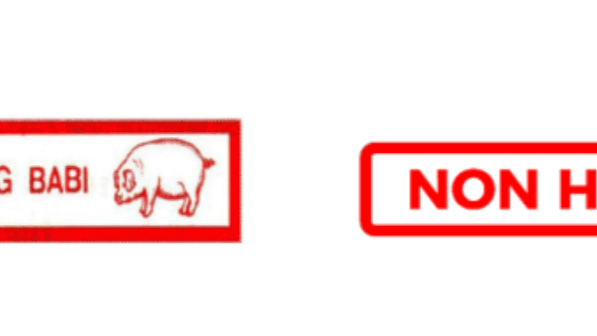
3.1 Design One: "Mengandung Babi" (Contains Pork)
This label is mandatory for products originating from pigs and their derivatives:
| Element | Specification |
|---|---|
| Text | "MENGANDUNG BABI" (Contains Pork) |
| Image | A pig illustration |
| Color | Red text and red rectangular border on white background |
| Format | The text and pig image are enclosed in a red rectangular box |
Important: For products in this category, text alone is insufficient—the pig image is mandatory. If the product packaging itself is red, a different text and background color may be used, provided there is sufficient contrast for readability.
3.2 Design Two: "Non Halal"
This label applies to products originating from materials other than pigs and their derivatives, or products produced through a non-halal production process:
| Element | Specification |
|---|---|
| Text | "NON HALAL" |
| Image | None |
| Color | Red text and red rectangular border on white background |
| Format | The text is enclosed in a red rectangular box |
Examples of products requiring this label:
- Products containing alcohol (e.g., certain flavorings or extracts)
- Products containing animal-derived ingredients from non-halal sources (other than pork)
- Products processed using equipment or facilities not compliant with SJPH
- Products containing najis materials
3.3 Visual Representation of the Labels
Based on the official design specifications:
Label 1 — Contains Pork: red border, white background, red text and pig illustration.
Label 2 — Non Halal: red border, white background, red text, no image.
Part 4: Where and How the Statement Must Be Affixed
4.1 Placement Requirements
Under Article 22 of the regulation, the non-halal statement must comply with the following placement standards:
| Requirement | Detail |
|---|---|
| Proportional placement | Placed proportionally on the product packaging, specific product part, or specific product location |
| Visibility | Positioned in the most easily visible and readable area |
| Background contrast | The background design, color, or other elements must not obscure the size, shape, or color of the statement |
| Durability | Must not be easily erased, removed, or damaged |
For products sold in retail packaging, the statement must be affixed to the outermost packaging that the consumer receives.
4.2 Bulk Products
For products not sold in retail or individually packaged form—including products sold in bulk—the non-halal statement may be affixed to containers, dispensers, packaging, or other marking surfaces that are easily visible and readable.
Additional requirement for bulk products: Business actors must also attach supporting documentation demonstrating the product's non-halal status. This documentation may include:
- Production process flow
- Product composition
- Certificate of Analysis (CoA)
- Questionnaires
- Statements confirming the product originates from prohibited materials and/or involves a non-halal production process
4.3 Application to Pharmaceuticals and Medical Devices
The regulation also applies to pharmaceutical products, biological products, and medical devices. However, the affixation of the non-halal label must also take into account labeling requirements issued by the Indonesian Food and Drug Authority (BPOM) and the Ministry of Health.
Part 5: Practical Implications for Exporters
5.1 Product Portfolio Review
Exporters must conduct a thorough review of their product portfolio to determine which products require the non-halal statement. This includes:
- Products containing pork or pork derivatives (e.g., gelatin from pork, pork fat, pork extracts)
- Products containing alcohol above permissible thresholds
- Products containing animal-derived ingredients from non-halal sources
- Products processed using equipment or facilities that have been used for non-halal products without proper ritual cleansing
- Products containing microbial or genetically engineered materials that do not meet SJPH criteria
5.2 Packaging Redesign
For affected products, exporters must redesign packaging to incorporate the mandatory non-halal statement. This involves:
- Creating the standardized label design (red border, white background, red text)
- For pork-containing products: including the pig illustration
- Ensuring the label is proportionally sized, easily visible, and durable
- Coordinating with Indonesian importers to ensure compliance with both BPJPH and BPOM labeling requirements
5.3 Documentation Preparation
For bulk products, exporters must prepare supporting documentation that demonstrates the non-halal status of the products. This documentation must be available for inspection by BPJPH or relevant authorities.
5.4 Transition Period Compliance
Products that entered, were distributed, or were traded in Indonesia before 23 July 2026 have a 12-month transition period ending 23 July 2027 to comply with the new labeling requirements. Exporters should use this period to:
- Review existing product packaging
- Update designs to include the non-halal statement
- Prepare supporting documentation
- Coordinate with importers and distributors
5.5 Impact on Market Positioning
The mandatory non-halal statement has significant market implications:
For products that cannot be made halal: The statement provides legal certainty and allows continued market access, but may limit the product's appeal to Muslim consumers.
For products that could be reformulated: The regulation creates an incentive to reformulate products to remove prohibited ingredients and pursue halal certification instead, opening access to the broader Muslim consumer market.
For importers and retailers: Clear labeling requirements reduce the risk of consumer confusion and potential regulatory violations.
Part 6: Industry Concerns and Implementation Challenges
6.1 ALPHI's Call for Clarification
The Indonesian Halal Inspection Agency Association (Asosiasi Lembaga Pemeriksa Halal Indonesia, ALPHI) has raised several implementation concerns:
Product criteria not addressed: ALPHI Chairman Elvina A. Rahayu noted that the regulation only addresses material and production process criteria, but does not address product criteria—including product names or shapes that may be non-compliant with Sharia even if materials and processes are compliant.
Unclear mechanism for certified products that become non-compliant: The regulation does not specify what happens when a product already holding a halal certificate is found during supervision to no longer meet SJPH requirements. Should the business actor immediately affix a non-halal statement, or should the halal certificate be suspended or revoked?
Verification mechanism unclear: ALPHI questions whether compliance is verified through audit or self-declaration by business actors.
6.2 Awareness and Socialization Challenges
Given Indonesia's archipelagic geography, ALPHI emphasizes the need for massive socialization efforts to ensure uniform understanding among field supervisors and business actors. Differences in perception could lead to inconsistent enforcement.
6.3 Potential for Consumer Confusion
There is a risk that consumers may misinterpret the non-halal statement. The regulation is designed to provide transparency, but without adequate consumer education, the statement could be perceived as a warning rather than neutral information.
Conclusion
BPJPH Regulation No. 3 of 2026 establishes a mandatory non-halal labeling regime that runs parallel to Indonesia's halal certification system. For exporters to Indonesia—including Swiss manufacturers—the regulation creates a clear compliance pathway for products that cannot be certified halal.
Key takeaways:
- Two label designs: "MENGANDUNG BABI" (with pig image) for pork-containing products; "NON HALAL" for all other non-halal products
- Strict placement requirements: Proportional, visible, readable, durable, with adequate background contrast
- Bulk products: Must have supporting documentation in addition to the label
- 12-month transition period: Ends 23 July 2027 for products already in the Indonesian market
- Pharmaceuticals covered: Also applies to drugs, biological products, and medical devices, subject to BPOM requirements
Recommendations for exporters:
- Audit your product portfolio to identify products requiring the non-halal statement
- Redesign packaging to incorporate the standardized label
- Prepare supporting documentation for bulk shipments
- Monitor regulatory developments as BPJPH may issue implementing guidelines to address ALPHI's concerns
- Coordinate with Indonesian importers to ensure compliance with all applicable labeling requirements (BPJPH, BPOM, Ministry of Health)
As Indonesia moves toward the 17 October 2026 full enforcement deadline for mandatory halal certification, the non-halal statement regime ensures that products outside the halal system can still access the Indonesian market—provided they are transparently labeled and compliant with the new regulatory framework.
Badan Penyelenggara Jaminan Produk Halal (BPJPH)SwissCham Indonesia
Embassy of Switzerland in Indonesia
Swiss Business Hub Southeast Asia + Pacific

Office Locations
Halal Certification Services (HCS) certifies companies all over the world. Our locally-based auditors can speak and assist in your local languages. Find the contact details of our offices nearest to you as mentioned below: